
Have You Ever Wondered Why Chamomile Flowers Look So Much Daintier And More Complex Than Regular Common Lawn Daisies?
Beneath the soft white petals and bright yellow central disc lies a hidden structural quirk that helps the species thrive across dozens of wild and cultivated habitats globally.
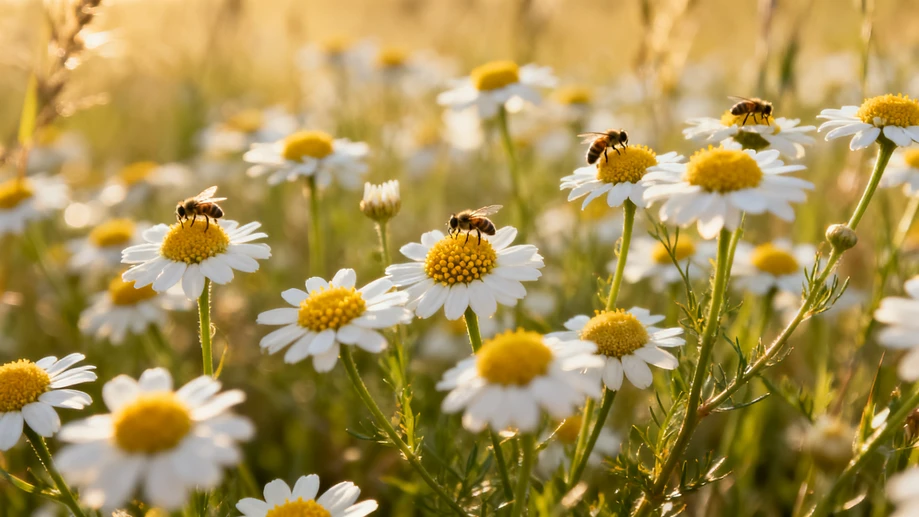
Rolling stretches of sun-dappled meadow across temperate regions of Eurasia and North America are often dotted with carpets of tiny, soft-looking white blooms that rise no more than 30 centimeters above the low grassy undergrowth. From a few meters away, these clusters of chamomile can be easily mistaken for common lawn daisies, with creamy white ray-like structures ringing a dense, rounded center of bright sun-yellow tissue. Even passing small pollinators that move no closer than half a meter will note that these blooms carry a faint, honey-like fruity scent that drifts through the air even on days with very little wind, a trait that most common wild daisy varieties do not possess at all. The overall structure of each chamomile flower head fits neatly within the tip of a finger, with no single part looking oversized or out of alignment with the rest of the delicate little plant.
The most little-known fact about chamomile’s physical form is that none of the soft, white petal-like structures ringing the yellow center are actual single petals. Each of those thin, slightly curved white blades is a fully formed, individual unisexual female flower, complete with its own tiny ovary, stigma, and protective sepal structure tucked in at the base where it connects to the shared core of the flower head. What most onlookers mistake for the yellow center “pad” is not a solid mass of tissue either, but a tightly packed collection of even tinier, individual bisexual flowers, each with its own minuscule stamen and pistil that sits raised just far enough off the base to catch drifting pollen grains. A single fully mature chamomile flower head can hold between 100 and 200 of these tiny separate flowers, all packed into a circular space that measures barely 2 centimeters across.
This unique structural arrangement gives chamomile a massive survival advantage that few other members of the daisy family can match, particularly when resources for pollination are scarce. Unlike larger, single-petal flowers that require a large pollinator to land directly on their sensitive reproductive organs to transfer pollen, chamomile’s arrangement means even the tiniest of pollinators, including minute solitary bees, tiny beetles, and even small pollinating flies that weigh less than a milligram, can brush against a dozen or more individual flowers in a single short landing. Even in seasons where pollinator populations are far lower than average, a high percentage of the tiny individual flowers on each chamomile head will successfully receive pollen and develop a viable seed, letting the species propagate steadily even in harsh, unfriendly growing conditions that would wipe out far more showy, large-flowered related species.
The layered, dense arrangement of tiny individual flowers also explains the unusually strong, long-lasting scent profile that chamomile carries compared to similar wild meadow blooms. Every single one of the individual flowers on the chamomile head has its own tiny essential oil gland located at the base of its ovary, right next to the small, green fleshy base of the main flower head. When warm daytime sunlight hits the surface of the flower head, all these hundreds of separate oil glands release tiny molecules of aromatic oil into the surrounding air in a steady, consistent stream, rather than releasing all their stored scent in one short burst. This slow, gradual scent release means a single chamomile flower head can emit a detectable aromatic trail for up to several meters around itself for more than two full weeks after it first blooms, drawing in far more passing pollinators than flowers that only release their scent for a few hours a day.
This specialized physical design even offers extra protection to the next generation of chamomile seedlings that sprout in the same patch of meadow later on. As the individual tiny flowers on the mature head finish their lifecycle and drop off to disperse their seeds, the soft white female ray flowers will also gradually loosen and fall onto the soil directly below the parent plant. The residual aromatic oils stored in the base of those small white flowers break down slowly into the top layer of soil, creating a thin, natural bioactive barrier that suppresses the growth of common soil fungi that would otherwise attack the tender new roots of sprouting chamomile seeds. No extra energy or resources are wasted by the plant in this process, as every single part of the flower head that developed through the growing cycle gets repurposed to support the next generation, making chamomile one of the most efficiently structured and resilient small wildflowers across its entire native range.