
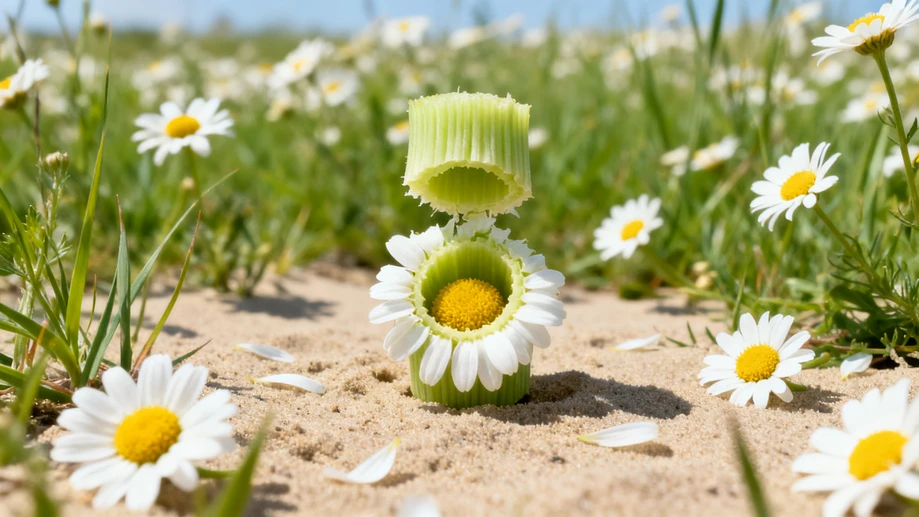
Did you know the tiny wild chamomile bloom hides a hidden intricate floral structure that you have most likely never observed carefully in your daily life?
This little explored detail of chamomile’s physical form explains why the delicate herb releases its distinct sweet apple-like scent only under specific gentle natural conditions.
Most casual observers mistake a full chamomile flower head for a single small bloom with a cluster of yellow centers surrounded by a ring of white petals, but this assumption overlooks one of the most unusual structural traits across the entire daisy family. Every rounded chamomile head is actually a tightly packed composite arrangement made of 100 to 200 completely independent tiny individual flowers, rather than one single organism with separate petal and stamen parts. This layered arrangement is so compact that the whole structure is less than three centimeters across even when fully unfurled under bright summer sun, making it easy for the distinct separate floral units to blend together into the appearance of one simple unified flower.
The soft white ribbon-like structures that most people identify as outer petals are not simple accessory parts of a larger central bloom, but fully formed individual female flowers that lack stamens entirely. Each of these white ray flowers contains its own separate ovary, and the thin extended white edge that gives the bloom its daisy-like appearance is a single stretched petal evolved to draw the attention of passing pollinator insects. The bright yellow bumpy cluster at the center of the flower head is no less remarkable, as every small raised yellow dot on that textured surface is a tiny tubular perfect flower that holds both stamens and a separate ovary capable of producing a viable seed.
What sets chamomile apart from all other visually similar small daisy-like plants in the same growing regions is the unique hollow cup-shaped receptacle that sits directly beneath the clustered mass of yellow and white flowers. If a fully mature chamomile bloom is split perfectly in half along its vertical axis, there is no solid dense fleshy core connecting the flower head to the thin green stem, instead there is a clean empty rounded cavity lined with a thin layer of soft pale green tissue. No other common member of the chrysanthemum or daisy genera that shares chamomile’s pale white petals and bright yellow center has this completely hollow internal structure, a trait that makes unlabeled chamomile samples instantly distinguishable from lookalike species with no extra testing required.
This tiny hidden hollow cavity serves far more than a passive structural purpose for the chamomile plant, and is directly linked to the herb’s famous soft sweet apple-like fragrance. All the tiny oil glands that produce chamomile’s signature volatile essential oils are positioned right at the base of every small tubular flower and along the underside of each ray petal, so the compounds these glands release drift directly into the empty hollow receptacle cavity instead of escaping immediately into the open air. The space acts as a tiny natural storage chamber, letting low concentrations of aromatic compounds build up slowly over hours of gentle sun exposure instead of dispersing into the wind the second they are produced.
Only when the ambient surrounding temperature stays steadily between 20 and 24 degrees Celsius for more than one full hour does the pressure of the accumulated aromatic compounds inside the hollow receptacle rise high enough that the scent seeps out through the small gaps between the clustered individual flowers to drift across the surrounding landscape. This is the exact reason that wild chamomile patches do not release their signature strong scent in the cool early morning or the cool late evening, and only fill the air with their distinct soft aroma for a narrow window of one to three hours in the warmest part of a cloudless mild summer afternoon.
The hollow receptacle structure also offers small but meaningful survival benefits for chamomile plants growing in well-drained sandy soils that dry out very quickly after rainstorms. When light summer showers fall on fully open chamomile blooms, a small amount of clean rainwater gets trapped inside the empty cup shaped cavity under the flower cluster. This small pool of captured water is slowly drawn down through the thin tissue of the receptacle and into the short main stem of the plant over the following hours, giving the shallow root system an extra small reserve of moisture that lets the plant survive an extra two to three days of hot dry weather without access to fresh rain.