
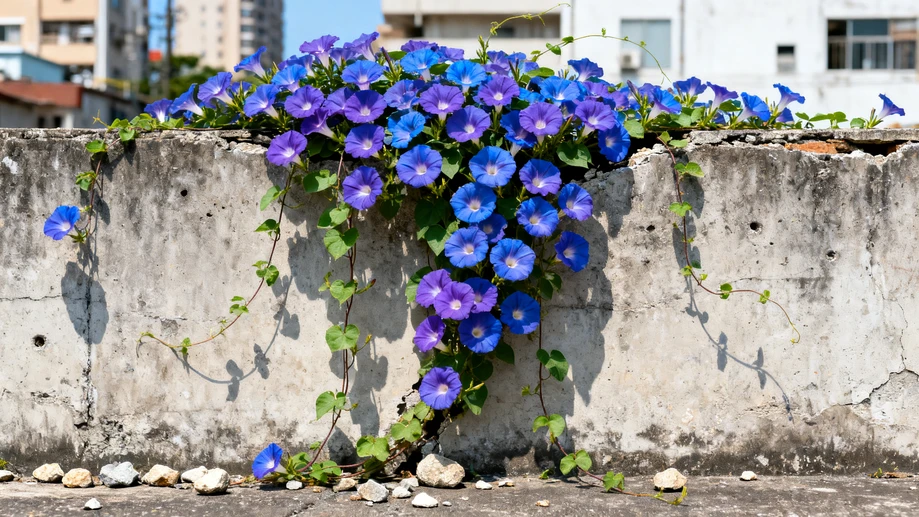
Do You Know The Ordinary Morning Glory Growing In Random Street Cracks Hides Unbelievable Survival Secrets Most People Overlook
This fun casual science post breaks down the little known adaptive traits of morning glory that let it thrive even in nearly barren, uninhabitable spots no other common ornamental plant can survive
If you have ever wandered around an old downtown residential block or a rarely visited abandoned alley in late summer, you must have spotted that bright cluster of sky-blue or soft purple morning glory blooms popping out from a tiny crack in a cement wall or a gap between asphalt paving slabs. Most passersby glance at it briefly and assume someone must have planted there on purpose, or the seed accidentally fell into that spot by pure luck, and it could only survive for a couple of days at most before drying out. But the truth is far more interesting than that casual assumption, these small seemingly delicate flowering vines have evolved extremely targeted survival mechanisms over thousands of years to grow perfectly in these spots where almost no other ornamental plant can last for more than a week.
The first of these little known super traits sits in its tiny newly sprouted root system. Within 72 hours after the morning glory seed breaks its tough outer shell and pushes out its first thin white taproot, the tiny root tip will secrete a very mild, non-corrosive weak organic acid that most amateur gardeners have never heard of. This special substance works slowly but steadily to dissolve the trace mineral particles in the cement dust, crushed gravel and hard wall deposits that no regular houseplant root can break down, turning those otherwise useless inorganic substances into absorbable nutrients that feed the young vine. The taproot will also stretch and bend itself to follow every tiny empty cavity hidden deep inside the wall crack, easily reaching 12 to 15 centimeters deep to find the tiny pile of accumulated dead leaf dust and decayed organic matter no human eye can spot, even if the surface of the gap you can see has less than 2 millimeters of loose material.
Its climbing vine also has a tiny built-in navigation system that lets it grab the maximum possible sunlight without wasting extra energy wandering around. The soft new growing tip of the morning glory vine will make a slow full 360 degree spiral rotation roughly every 60 to 70 minutes, continuously scanning the 30 centimeter radius around it for any hard vertical or tilted object that it can wrap itself around. A rusted old wire fence, an exposed plastic drain pipe, the raised uneven line between two wall bricks, even the rusty frame of a discarded old metal chair left by the roadside will all be locked onto as a perfect support. Once it finds a proper anchor point, the vine will twist itself tightly around the object and climb upwards at an average speed of nearly 7 centimeters per day, bringing its leaves and soon-to-form flower buds high above the weeds that get regularly stepped on by passersby, to catch the full direct morning sunlight that it needs to bloom.
For decades many city maintenance crews used to treat these wild growing roadside morning glories as useless invasive weeds and pull them out regularly, until recent urban ecology studies found these uninvited little vines are actually super low-cost natural environment improvers that require zero human intervention. Their root systems lock down the loose dust and fine sand trapped in road cracks that would otherwise get blown into the air by every passing car, cutting down the amount of road dust by nearly 30% in narrow alleys where these vines are allowed to grow freely. Their wide thick leaves also catch the tiny particulate residues from vehicle exhaust that stick to nearby surfaces, and their roots can absorb and store trace amounts of heavy metals left in the stagnant rainwater trapped inside pavement gaps, far more effectively than many deliberately planted high-maintenance landscape flowers that need weekly watering and regular fertilizing to stay alive.
Next time you take a slow walk on a warm late summer morning, take a few extra seconds to stop and look at the clumps of morning glory you spot growing out of seemingly impossible spots. You do not need to dig them out and transplant them into a fancy flower pot, they will grow far better in that small crack than in the nutrient rich soil you prepared for them. Many people have spent lots of time and money on expensive delicate ornamental plants that wilt and die after a single missed watering, but these humble little vines, with no one to tend to them, no one to loosen their soil or give them extra nutrition, will still bloom fresh new flowers every single dawn for three full months, bringing a tiny unexpected bright spot to the dullest gray concrete corner you pass every single day.