
Have You Ever Wondered Why Most Tropical Wild Orchids Never Root In The Dark Rainforest Floor Dirt?
This post breaks down the little-known survival trick that lets 70 percent of global orchid species thrive high on tree trunks instead of competing for space on crowded ground.
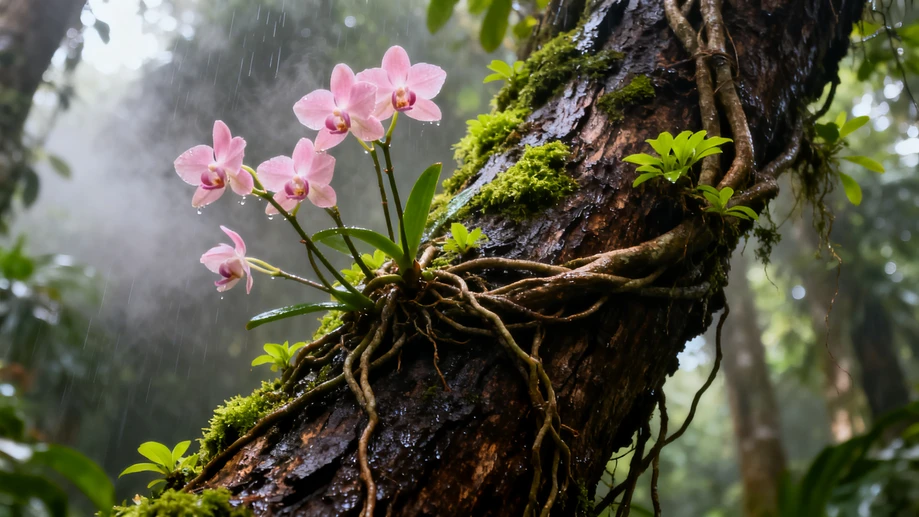
When visitors walk along elevated hiking trails in lowland tropical rainforests, they often spot clusters of bright, delicate orchid blooms tucked into the crevices of thick tree branches 10 to 20 meters above the ground. Many first-time travelers assume these flowers are hung up by park staff as part of scenic decoration, and never stop to think that this spot high above the dirt is exactly the natural, preferred growing environment for the majority of wild orchid species on the planet. The common sight of potted orchids on supermarket shelves or home window sills has trained most people to associate these flowers with potting soil, but the vast majority of orchids that evolved naturally in warm, humid forest regions never evolved to handle being buried under layers of compacted earth at all.
The secret behind this unusual growing preference sits in their specially modified root system, which looks different from the roots of nearly all common garden flowers. The outermost layer of every wild orchid root is covered with a thick, spongy white tissue called velamen, which acts like a built-in sponge that can absorb and hold several times its own weight in rainwater in just a few seconds when tropical showers roll through. This layer also has tiny openings that pull water vapor and trace nutrients straight from the humid forest air, and the cells under the velamen even contain small amounts of chlorophyll that can carry out photosynthesis directly, turning sunlight into energy without needing to be buried under dirt at all. These roots only need a rough, textured surface to lock themselves onto, and scattered bits of dead leaf, bird droppings and decaying moss caught in the gaps between roots are more than enough to supply all the trace minerals the orchid needs to bloom and produce seeds for the next generation.
For decades, old forestry guidebooks incorrectly labeled these wild epiphyte orchids as parasitic pests that slowly drain nutrients out of their host trees and kill healthy mature woody plants over time, but modern field research has proven this assumption to be completely wrong. Orchid roots never pierce through the outer bark of their host trees to reach the inner nutrient-carrying vascular tissue, and they do not take any resources that the tree was already using to grow. On the contrary, the small cluster of roots and decaying organic matter collected around the orchid’s base creates a tiny, moist micro-ecosystem on the tree trunk that catches fine water droplets during light rain, feeds small pollinating beetles and ants, and even slows down excessive moisture loss from the tree’s bark during short dry spells. The relationship between the orchid and its host tree is a perfect example of commensalism, where one species gets all the benefits of the arrangement and the other faces no harm at all.
This little known growth detail also explains why so many new home gardeners kill their first potted orchid within just a few months of bringing it home. Most people follow the standard planting routine for other houseplants: dig a hole in regular garden soil, tuck the orchid in, pat the dirt down tight around the roots, and water it every other day. This routine is basically a death sentence for the orchid, because the compacted soil blocks all air flow to the orchid’s special spongy roots, traps excess moisture against the root tissue for days on end, and causes fast-spreading root rot that turns the entire root system brown and mushy in less than two weeks. The special orchid growing medium sold at local plant stores, which is usually made of chunks of pine bark, broken coconut shell and porous volcanic rock with no fine dirt mixed in, is designed specifically to mimic the open, well ventilated conditions of an orchid growing high on a tree trunk, so the roots can pull in fresh air at all times just like they would in their native rainforest habitat.
This small evolutionary choice that orchids made millions of years ago shows a surprisingly clever survival strategy that most people never notice. On the dark, crowded rainforest floor, every patch of sunlight is fought over by ferns, sprawling shrubs, fast growing weeds and hungry root-eating insects and fungi, making it almost impossible for small, slow growing flowering plants to get enough light to produce blooms. Orchids avoided all that unnecessary competition entirely by climbing up to the open sunlit canopy, where no other ground plant could reach, and adapted their bodies to thrive in a space no other flowering plant was using. They did not need to fight other species for limited resources on the ground, they simply invented a brand new living space for themselves, and that quiet, non-invasive cleverness is exactly why there are more than 28000 distinct wild orchid species living across nearly every continent on Earth today.