
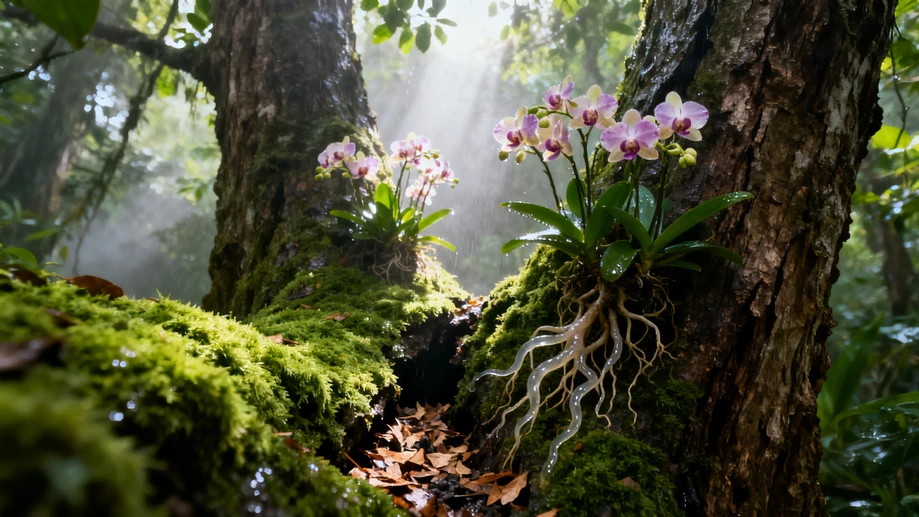
Have You Ever Noticed That Most Wild Orchids Never Actually Root Directly In Dirt Or Regular Garden Soil
This little documented growth habit behind delicate orchid species has surprised countless casual plant lovers who tend to small houseplant displays on their home windowsills
Anyone who has tried to keep a grocery store phalaenopsis alive past its initial bloom has likely stumbled across a very confusing piece of advice online, telling them they should never repot their new plant into the standard potting soil they use for pothos or monsteras. Countless new plant enthusiasts have written off their first orchid as a lost cause after dumping it into a rich, loamy bag of general purpose garden soil, only to watch the leaves turn mushy and yellow within two weeks, before the entire stem collapses at the base. Very few of these new hobbyists ever stop to wonder why orchids have such oddly specific care requirements, or why they react so badly to the exact same soil that makes almost all other common houseplants thrive. The answer lies in the very unorthodox natural habitat that most wild orchid species evolved in over tens of millions of years, a habitat most casual nature lovers have never actually observed in person even on guided rainforest walks.
Nearly 90 percent of all wild orchid species growing in tropical and subtropical regions never spend any part of their life cycle rooted deep in mineral rich ground soil at all. Instead, these orchids take up residence high up in the canopy of old growth rainforests, wedged into narrow nooks and crannies in the thick, textured bark of mature hardwood trees, where layers of damp moss, half decomposed leaf litter, and fine wind blown organic dust build up over decades to create a lightweight, moisture retaining pocket of material that bears almost no resemblance to what most people define as soil. These pockets rarely get deeper than three or four inches at their very thickest, so the orchid never needs to send long roots searching for water or nutrients deep underground, and all of its thick, spongy roots are designed to cling tight to the rough bark surface rather than push through dense, compacted earth.
This seemingly odd living arrangement gives wild orchids a long list of evolutionary advantages that no ground dwelling flowering species in the rainforest can access. Sitting dozens of feet above the damp, shadowy forest floor puts the orchids directly in the path of the soft, dappled sunlight that filters through gaps in the upper canopy, light levels that are far too bright for most low growing ground plants that have adapted to survive on near darkness. The elevated position also keeps their delicate root systems far away from the pools of stagnant water that collect on the ground every time heavy monsoon rains pass through the forest, eliminating almost all risk of fungal rot that kills more rainforest plants than any other single environmental factor. It also keeps the flowers safely out of reach of most ground dwelling herbivores and crawling insects that would otherwise eat every bloom before pollinators could ever find them.
That tiny quirk of evolution is exactly the reason why regular garden soil kills potted orchids so quickly, even when a plant owner sticks perfectly to every other piece of standard care advice. Dense loam soil packs tight around the orchid’s air loving roots, cutting off their access to the constant flow of fresh circulating air they evolved to depend on, and traps so much standing water against the thin outer layer of the root that the entire structure rots away in less than a week. This is the reason all orchid care guides recommend using chunks of pine bark, dried sphagnum moss, or coarse perlite as a growing medium instead, materials that stay loose and airy even when fully saturated, and mimic the exact texture of the organic debris that collects in rainforest tree bark nooks far more closely than any bag of standard potting mix ever could. Even the common practice of hanging mounted orchids on wooden planks instead of putting them in pots has its roots directly in this natural growth habit, letting the plant’s roots hang fully exposed to the air the way they would in their native rainforest home.
Even the pale silvery green color of a healthy orchid’s exposed roots is a side effect of this unusual growth environment, as the thin outer layer of the root called the velamen contains small amounts of chlorophyll that can perform photosynthesis the exact same way the plant’s leaves do. That adaptation lets the orchid collect small amounts of energy even during periods of the year when it drops all of its leaves to survive extended dry spells, meaning some wild orchids can survive and even produce full blooming flower spikes for months at a time without growing a single leaf at all. It is a tiny, easy to miss detail that most people walk past their whole lives without noticing, until they stop to look closely at the small houseplant sitting on their kitchen windowsill, and realize the delicate little flower they keep on their counter has evolved a whole set of bizarre, specialized traits to survive in a habitat most people would never guess it calls home.