
Have You Ever Noticed That Wild Orchids Often Pretend To Be Tiny Insects To Lure Unwitting Pollinators?
Almost all wild orchid species across temperate zones have evolved surprisingly detailed petal mimicry that perfectly copies local insect features to boost pollination success.
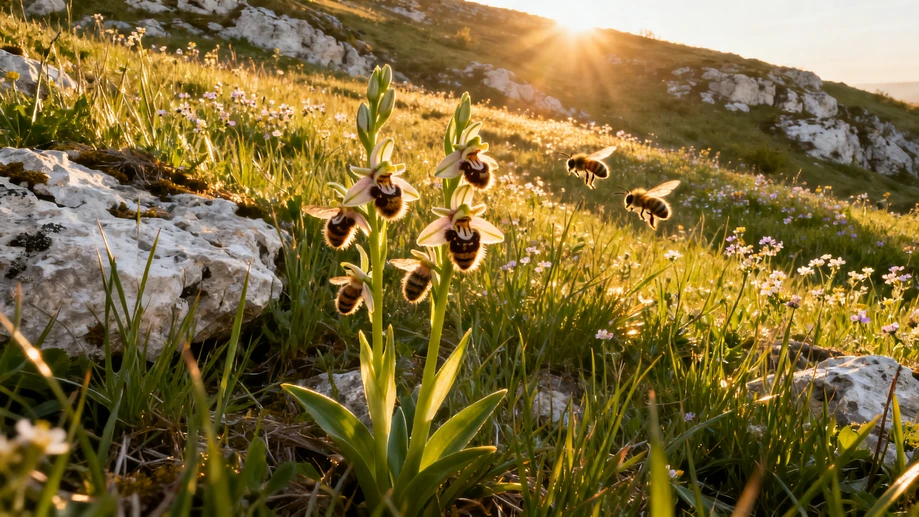
On sun-warmed limestone meadows across Eurasia, where bright clover blooms nod between tufts of fine grass, it is easy to mistake small, fuzzy, wing-shaped growths clinging to thin flower stalks for slow-moving female bees resting after a long flight. These soft, spotted shapes catch the golden hour light the exact same way the chitin exoskeletons of local solitary mining bees do, and their dark veined texture lines up perfectly with the faint wing patterns etched onto the back of a newly emerged adult bee. Few casual observers realize at first glance that these tiny “bees” are not living creatures at all, but specially modified lower petals belonging to a small group of terrestrial wild orchids that have perfected one of nature’s most impressive visual disguise tricks.
Every tiny detail of this specialized petal structure has been refined over millions of years of evolution to match the exact appearance of the local pollinator species it targets. The fine, translucent hair-like structures coating the surface of the “fake bee” mimic the soft fuzz covering a real female mining bee’s abdomen, the dark brown and yellow spotted bands line up precisely with the exact pigment distribution seen on the bee’s back, and the slightly raised edge along the sides of the petal creates an optical illusion that tricks passing male bees into seeing folded, resting wings. Even the shape of the petal’s base is curved to match the exact posture a female bee will take when perching on a grass stem waiting for a mate, so the unsuspecting male will land on the surface without hesitation as soon as he spots the shape from meters away.
This extreme focus on visual mimicry rather than investing energy in producing sweet, sugar-rich nectar comes directly from the harsh, nutrient-poor growing environment these orchids call home. The shallow, thin soil on top of exposed limestone formations holds very little accessible nitrogen and sugar for plant growth, making it nearly impossible for low-growing wild plants to produce the large volumes of nectar most flowering species use as a reward to draw in pollinators. Rather than wasting the limited nutrients they pull from the soil to make a food source no creature actually needs for this interaction, these orchids have reallocated almost all their available growth energy to refining their petal shape, texture and color, cutting their total resource expenditure for each bloom to a tiny fraction of what other flowering plants living in the same habitat spend.
The mimicry trick works so reliably that male mining bees will often linger on the orchid’s petal for several seconds, running through the full set of mating behaviors they would normally direct towards a real female bee. During this small window of contact, the two sticky pollen sacs perched on the top of the orchid’s flower column will attach firmly to the back of the bee’s head or thorax, right at the perfect height to brush against the sticky stigma of the next orchid bloom the bee mistakenly visits later. No nectar is exchanged, no food is consumed, and the entire pollination process runs its full course without the orchid expending any extra resources to reward the insect for its work. Over evolutionary time, this strategy has proven so effective that these orchid populations can spread across entire meadow slopes even when pollinator numbers are relatively low for most of the spring season.
The special insect-shaped petals only stay in place for two weeks or less each flowering cycle, once pollination is complete, the whole flower stalk will droop gently as the small swelling at its base begins to develop into a thin, elongated seed pod packed with thousands of dust-sized orchid seeds. These tiny, nutrient-free seeds will drift across the meadow on soft spring breezes until they land in a patch of loose humus near the roots of a specific mycorrhizal fungus, which will feed the tiny germinating orchid for its first full two to three years of life before it can grow its own first set of small, rounded green leaves. The whole cycle unfolds entirely hidden under the layer of grass blades for almost the full year, only breaking cover for that short, bright two-week window to show off the perfect fake bee shapes that keep their quiet little lineage thriving across the wild meadow landscape.