
Have You Ever Noticed How the Sensitive Plant Thrives in the Most Unexpected Places?
Discover the fascinating world of Mimosa pudica and its remarkable ability to adapt to diverse environments, from lush tropics to urban cracks.
You've probably encountered the sensitive plant, or Mimosa pudica, in a friend's garden or even as a quirky houseplant, where its leaves instantly fold at the slightest touch—like a shy dancer retreating from the spotlight. But beyond this charming party trick, this humble plant has a secret life rooted in its incredible adaptability to various habitats. It's not just a curiosity; it's a survivor that thrives in places many other plants would wither. Picture this: a patch of Mimosa pudica flourishing along a sun-drenched roadside, its delicate pink flowers nodding in the breeze, while cars zoom past. This real-world scene highlights how the plant's environment shapes its growth, turning everyday cracks and crevices into unexpected sanctuaries. By focusing on its habitat, we uncover a story of resilience that mirrors our own urban jungles, making it a perfect subject for anyone curious about nature's hidden dramas.
Typically, Mimosa pudica calls tropical and subtropical regions its home, basking in warm, humid climates where rainfall is plentiful and temperatures rarely dip below 60 degrees Fahrenheit. Think of the dense rainforests of South America or the sun-soaked fields of Southeast Asia—these are its natural playgrounds, where it carpets the forest floor in a sea of green, thriving in well-drained soils rich in organic matter. Here, the plant's rapid growth is fueled by abundant sunlight, allowing it to spread quickly and form dense mats that outcompete weeds. Yet, this isn't just about ideal conditions; the sensitive plant has evolved to handle occasional droughts by curling its leaves to conserve moisture, a clever trick that keeps it alive during dry spells. Observing it in such settings, you'd see how it weaves itself into the ecosystem, providing shelter for tiny insects and enriching the soil with nitrogen—a silent hero in the biodiversity web.
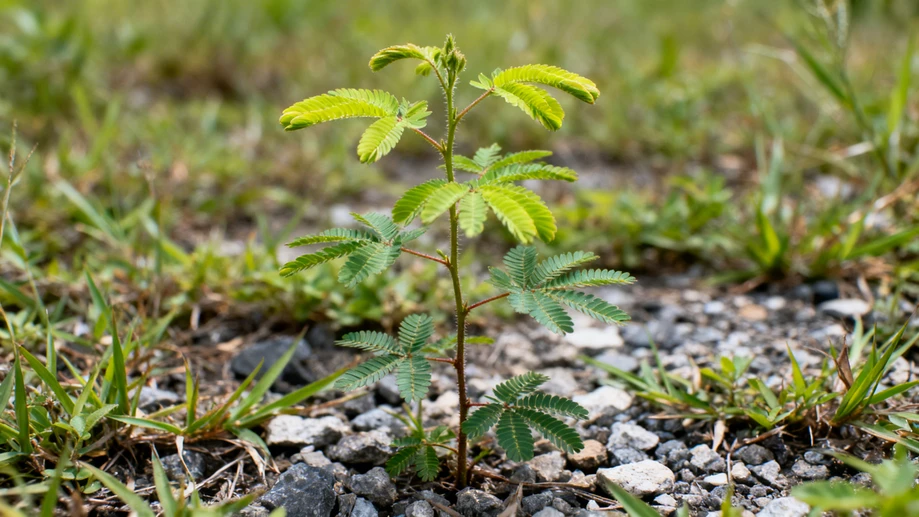
However, the real magic happens when Mimosa pudica ventures beyond its comfort zone, adapting to urban landscapes with surprising ease. Unlike many delicate species, it doesn't shy away from concrete jungles; instead, it colonizes abandoned lots, railway tracks, and even the edges of parking lots, where poor soil and pollution would doom most plants. This adaptability stems from its hardy root system, which anchors firmly in gravelly or compacted earth, drawing nutrients from the most unlikely sources. For instance, in cities like Miami or Bangkok, you'll find clusters of these plants sprouting through sidewalk cracks, their leaves unfurling defiantly amid the hustle. This shift from pristine forests to gritty urban settings isn't just a fluke—it's a testament to the plant's evolutionary prowess, turning neglected corners into vibrant green oases that remind us of nature's tenacity.
Building on this resilience, Mimosa pudica's growth is finely tuned to specific environmental cues, making it a master of survival in fluctuating conditions. It prefers full sun but can tolerate partial shade, and while it loves moisture, it's remarkably drought-tolerant once established—perfect for unpredictable weather patterns. The plant's sensitivity to touch isn't just a novelty; it's a defense mechanism against herbivores in crowded habitats, where quick reactions mean the difference between life and death. In practical terms, this means that in your own backyard or a community park, you can spot it thriving with minimal care, often in sandy or loamy soils that mimic its wild origins. Yet, there's a catch: it can become invasive in non-native areas, spreading rapidly and outcompeting local flora. This duality—its beauty and potential for disruption—highlights why understanding its habitat is key to appreciating its role in our ecosystems, urging us to observe rather than interfere.
Ultimately, the story of Mimosa pudica's environment is a powerful reminder of nature's ingenuity, showing how even the most unassuming plants shape our world. By studying its habitats, we gain insights into broader ecological themes, like adaptation and sustainability, that resonate in an era of climate change. So next time you pass a weedy patch or a neglected garden corner, take a closer look—you might just spot this sensitive survivor, quietly thriving against the odds and inviting us to marvel at the everyday wonders underfoot.