
Have You Ever Noticed That Most Widely Seen House Orchids Never Actually Need Traditional Potting Soil To Thrive?
Discover the hidden growing habits of common household orchids that most people overlook, explaining how these unique plants draw nutrients from air, bark and tiny floating particles to stay healthy for years.
Walk through any grocery store floral section, community farmers market or neighborhood plant shop, and you will almost certainly spot racks of blooming phalaenopsis orchids tucked into small plastic pots, usually filled with clumpy dark material many new plant owners mistake for regular potting soil. Countless new orchid caretakers make the common mistake of repotting their new purchase straight into garden soil or standard houseplant mix, only to find soft brown rot creeping up the stem within two weeks, and the once bright blooms dropping off one by one. Most people blame their own lack of plant care skill for this rapid decline, but the real issue stems from a fundamental misunderstanding of where these orchids evolved to grow, and what their roots are actually built to do.
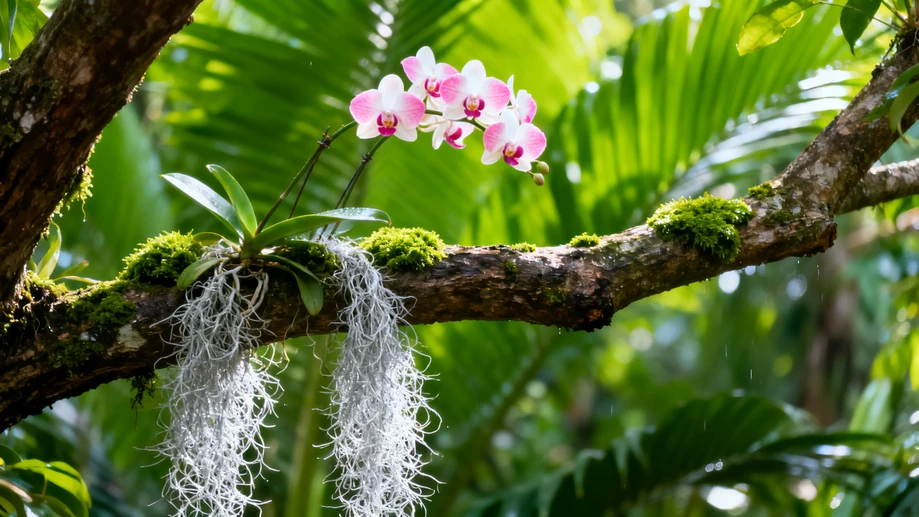
Almost all common house orchids you see sold commercially are epiphytic species, which means in their native tropical forest habitats, they never touch soil at all. These orchids anchor themselves firmly to the rough, sun-exposed bark of tall canopy trees, perching several meters above the damp dark forest floor where low light, competing fungi and foraging ground insects would pose constant threats to their survival. Their thick, pale exposed roots are covered in a spongy, absorbent layer called velamen, which acts like a natural sponge to catch and hold rainwater, dissolved trace nutrients from decaying leaf litter that washes down tree trunks, and even tiny particles of organic matter floating through humid forest air. This specialized root system is not designed to push through dense, compacted soil that traps standing water against its delicate outer layers, which is why even highly experienced growers who accidentally bury orchid roots under heavy soil almost always see their plants fail within months.
This little known growing trait also completely rewrites the common set of unhelpful rules people pass around for caring for house orchids. There is no need for heavy, nutrient dense potting mixes, no need for deep watering that saturates the entire pot for days at a time, and no need for drainage holes that sit in a tray of standing water at all. Many hobbyist orchid growers now mount their common phalaenopsis, dendrobium and oncidium orchids directly onto flat slabs of natural cork bark, with nothing more than a small piece of natural twine to hold the root mass against the bark surface until the plant anchors itself. Once established, the mounted orchid only needs a quick 10 second soak under running lukewarm water once every 7 to 10 days, and a very light spritz of diluted orchid nutrient solution once every two months, to produce a full flush of blooms year after year, often for decades without ever being placed in any type of pot or soil medium. People who have struggled to keep orchids alive for more than a few months are often shocked the first time they try this no-soil method, watching their previously stunted plants produce new thick roots and flower spikes within just a few short weeks.
Over tens of millions of years of evolution, this epiphytic growing strategy has allowed orchids to become one of the most diverse groups of flowering plants on the entire planet, with more than 28,000 confirmed wild species spread across every continent except Antarctica. Most people who only ever see orchids sold in small store pots have no idea that more than 70 percent of all wild orchid species never interact with soil at all, growing on tree branches, cliff faces and even the thick stems of other large tropical plants far above the ground. This clever adaptation lets them skip all the competition for limited light and nutrients on the crowded forest floor, letting them access bright unfiltered sunlight at the top of the canopy that very few other non-epiphytic plants can reach. Their specialized roots are even capable of carrying out small amounts of photosynthesis on their own, so even if a few leaves drop off due to temporary stress, the plant can still produce enough energy to recover and grow new foliage without any extra intervention.
Even the so called “specialized orchid potting mix” sold in most plant supply stores is never made of real nutrient dense garden soil. It is usually a loose, airy blend of large chunks of pine bark, perlite, coconut husk chips and small pieces of charcoal, all designed to mimic the rough, uneven texture of natural tree bark, giving orchid roots something to cling onto while letting excess water drain away completely within a few minutes. The mix does not actually provide long term nutrients to the orchid the way regular potting mix feeds rooted houseplants, it only acts as a stable anchor point so the plant does not topple over as it grows. Many long time orchid enthusiasts even choose to skip this mix entirely, growing their plants in clear empty glass vases with nothing but a few spare pieces of decorative moss around the base of the roots, letting the roots get full access to fresh air and indirect sunlight to grow far faster than they ever would buried under layers of soil.