
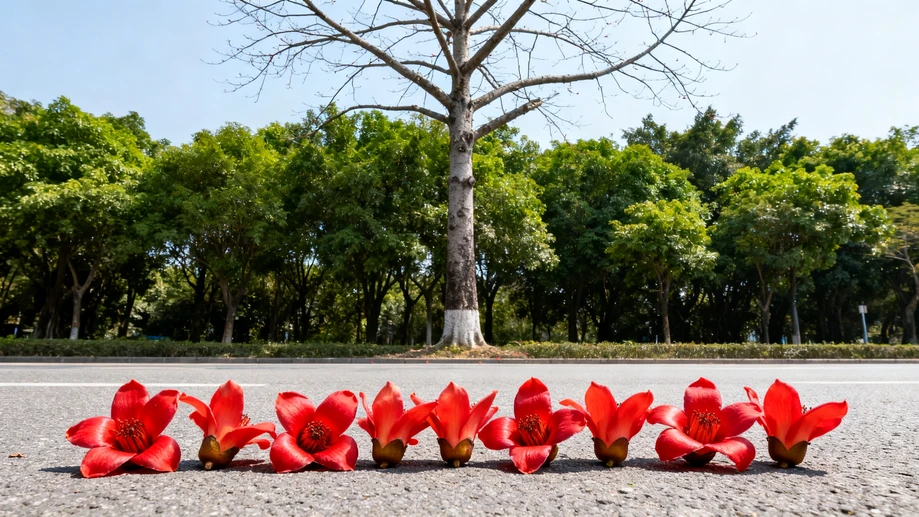
Have You Ever Noticed That Fully Bloomed Kapok Flowers Never Land Face Down When They Fall From Tall Sturdy Branches
This tiny hidden physical trait of the common tropical kapok bloom lets it preserve its full intact shape for days even after it hits hard paved ground below the tree canopy
Kapok trees grow across wide tropical and subtropical zones, reaching a maximum height of over 25 meters when they reach full maturity, with wide spreading branches that stretch far beyond the edges of most public road verges. When the flowering season arrives in late spring, all the green leaves fall off ahead of bud development, leaving the entire crown covered in layers of saturated scarlet blooms that catch direct unfiltered sunlight from dawn to dusk. Each fully opened flower measures between 10 to 12 centimeters across, with five layers of thick, fleshy petals that hold far more resilient moisture than the thin delicate petals of most other ornamental flowering tree species. The outer sepal structure at the base of each bloom slowly hardens to a lightly woody density as the flower reaches full maturity, no longer relying on soft nutrient rich tissue to stay attached to the branch point before natural detachment.
The center of gravity for every mature kapok bloom sits almost entirely at the thickened sepal end, a position that makes up less than one third of the total full length of the entire flower. All the dense, heavy stamen clusters and nutrient rich soft tissue that feed the developing seed pods are packed tightly inside this low center of gravity zone, while the large spread petals at the opposite end are made of loosely arranged fibrous cells that create extremely high air resistance during free fall. This structural arrangement creates a natural self correcting balance the moment a bloom detaches from its branch, with the heavy sepal end pointing downward automatically even when strong cross winds blow across the upper levels of the tree canopy. The wide, spread petals act exactly like the fabric of a small parachute, slowing the rate of descent enough to eliminate any spinning or rolling motion that would make the flower tumble and hit the ground at an odd angle.
Most other flowering tree species in the same ecological zones have their flower centers of gravity placed close to the exact midpoint of the bloom, which leads to random tumbling during free fall that slams thin petals against hard concrete or asphalt surfaces the moment they make contact. Most of those blooms shatter immediately on impact, leaving torn petal fragments scattered across the ground that turn mushy and dark after a few hours of exposure to sun and passing dew. Unlike those species, the kapok’s downward facing sepal absorbs 90 percent of the impact shock when it hits the ground, leaving the entire soft petal structure facing upward completely unharmed, with no scrapes, tears, or smudges from contact with the hard surface below. Even when blooms fall from the maximum 25 meter height of the tallest mature kapok trees, the soft layered petal structure at the top of the flower remains fully intact after landing, with no crumpling or creasing across the bright smooth surface of every individual petal.
This unexpected structural trait brings multiple small but measurable evolutionary benefits for the species that support its long term spread across large wild areas. The intact, upward facing open cup shape of the landed bloom catches and holds small pools of rainwater after light spring showers, creating tiny isolated water reserves for small native pollinator insects that travel across the ground after a rainstorm. The uncrushed petal structure stays firm and dry for three to four full days under continuous direct sunlight, slowly losing excess internal moisture until the entire bloom becomes light and dry enough to be picked up by light gusts of wind. Even after it is carried dozens or even hundreds of meters across flat ground, the dry kapok bloom still holds its cluster of tiny attached seeds safely inside its base, letting the seeds scatter across wide open empty plots of land far away from the shade of the parent kapok tree.
Over the full length of its multi week flowering season, the ground below a fully mature kapok tree becomes completely covered in an even, smooth carpet of bright scarlet blooms that all sit facing the sky, no messy crushed fragments or dark rotting pieces breaking the even uniform color across the entire surface. There is no external force or outside intervention that creates this orderly scene, every perfectly placed upright bloom is the natural result of millions of years of slow evolutionary adjustment to the species’ unique tall growing habitat. This tiny, easily overlooked physical trait turns a simple annual flowering cycle into one of the most visually striking natural displays found across all tropical and subtropical forest zones.