
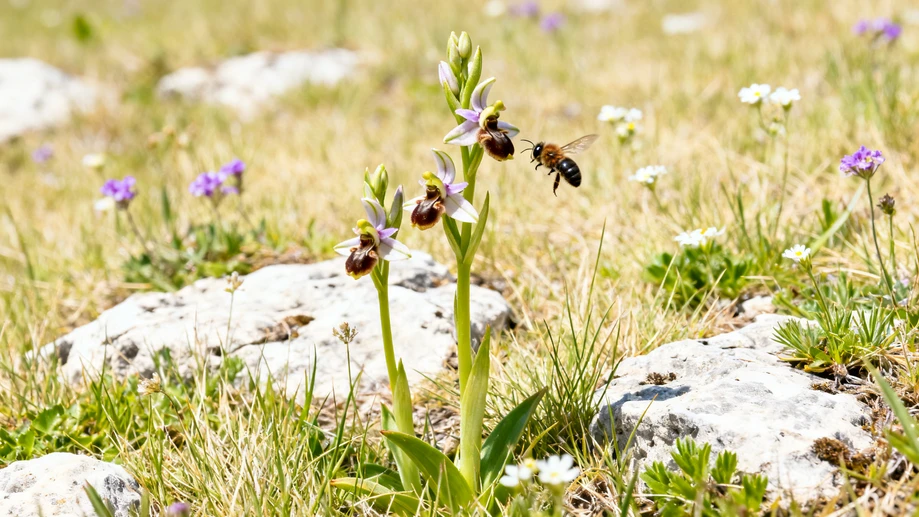
Have You Ever Noticed That Common Wild Orchids Can Fool Entire Local Bee Colonies With Nothing But Their Unique Shapes
This unassuming little flowering plant has evolved a near-perfect deception strategy to complete pollination without wasting any energy producing sweet nectar for visiting insects
If you have ever wandered through a local home and garden center or browsed a community plant sale on a warm spring weekend, you have almost certainly walked past shelves of potted orchids with vibrant, intricately shaped petals. Most people assume these bright, delicate blooms draw pollinators the same way roses or sunflowers do, by offering a small sip of sugary nectar as a fair trade for carrying pollen from one flower to the next. Very few casual observers stop to wonder why so many orchid varieties have weird, lumpy, fuzzy lower petals that look almost nothing like the smooth, symmetrical surfaces of other common garden flowers. That oddly shaped section of the orchid, called the labellum or lip, is not just a random quirk of horticultural breeding, it is the core of one of the most deviously clever survival tactics in the entire plant kingdom.
Wild orchid species that rely on this specific trick do not invest any of their limited energy resources into making nectar at all. Instead, they mold their labellum to match the exact size, texture, color pattern and even tiny fine hair distribution of a receptive female bee of one specific local species. The mimicry is so precise that it goes far beyond what the human eye can easily pick up at a glance. The surface of the labellum even exudes tiny quantities of a chemical compound that matches the exact sex pheromone released by that female bee when she is ready to mate, and the waxy coating on the petal reflects ultraviolet light in the exact same pattern as the female bee’s translucent wing membranes. To a male bee that has just emerged from his underground winter burrow several weeks before the females of his species hatch, there is literally no visible or olfactory difference between the orchid bloom and an ideal mating partner.
When the confused male bee lands on the orchid’s labellum and attempts to mate with what he thinks is a female, his back presses directly against the sticky pollen sacs tucked into the upper curve of the flower. He flies away a few seconds later, no doubt frustrated to have received no actual reward for his effort, and carries the full load of bright yellow pollen stuck to his thorax. When he encounters a second orchid of the same species a few meters further along the grassy slope, he falls for the exact same trick, and the pollen sacs on his back rub off directly against the sticky stigma of the new flower. The entire pollination cycle is completed in a matter of seconds, and the orchid has spent no extra energy producing sugar-rich nectar that would draw all kinds of random non-pollinating insects to its blooms. This strategy is so effective that many wild orchid pollination success rates are far higher than those of similar flowering plants that rely on generic nectar rewards to draw any passing bug.
This deceptive trait can only develop and survive in very specific, narrow sets of growing conditions. These orchid populations only thrive in open, sunlit limestone meadows where the exact corresponding bee species has established a large, stable local colony. The orchids even time their exact bloom window perfectly to align with the short two week period each spring when newly mature male bees are flying around looking for mates, right before the first female bees of the same species dig their way out of the soil. If the local temperature shifts enough to make the female bees hatch three or four days earlier than usual, the male bees will all find actual mating partners before the orchids finish blooming, and the entire local orchid population will produce no seeds that entire year. This tight, synchronized link between the orchid and its target bee means these wild orchid colonies are extremely sensitive to changes in local land use, pesticide application and shifting seasonal weather patterns.
Even the domesticated ornamental orchids that you see for sale in grocery store floral sections carry faint traces of this ancient deceptive trait in their oddly shaped lower petals. If you take a close look at the labellum of a common potted phalaenopsis or cymbidium orchid at home, you will spot tiny faint speckles, soft fuzzy patches and uneven curved edges that are leftover from thousands of years of evolutionary refinement to fool local pollinators. This tiny, easy-to-miss detail makes every orchid you keep on your windowsill a tiny living reminder of the wildly creative survival tricks that nature can develop when two unrelated species spend millions of years evolving side by side in the same small patch of meadow.