
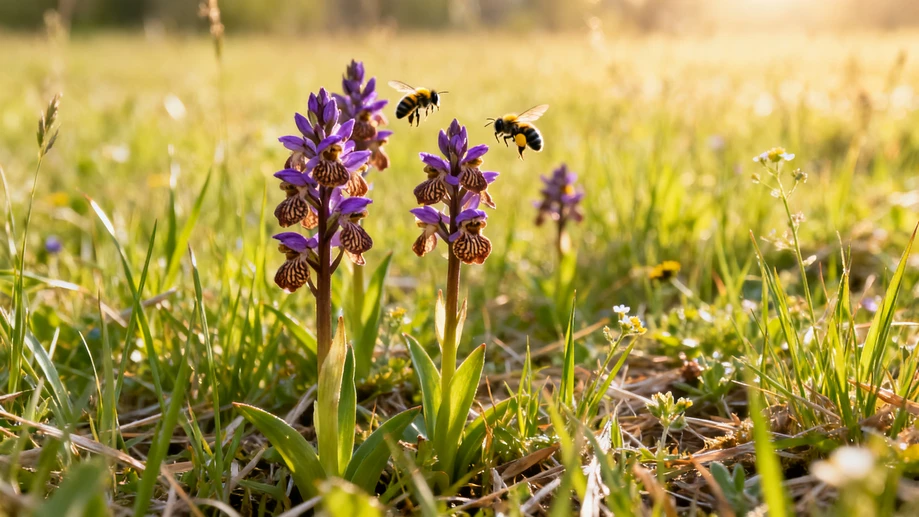
Did You Know Wild Terrestrial Orchids Trick Male Bees Into Pollinating Them Without Offering Any Nectar Reward
Explore the tiny, hyper-detailed physical traits that let these clever flowering plants pull off one of nature’s most absurdly effective reproductive strategies across undisturbed meadow habitats
If you wander along undisturbed lowland meadow paths in late spring, you might spot clusters of small, unassuming purple-brown orchids poking up between tufts of grass, no bigger than the palm of a hand from base to bloom. Most casual passersby would write these plants off as random common wildflowers, but they are actually some of the most masterful evolutionary works on the planet, with a suite of physical traits tuned so precisely to their pollinator targets that human observers often cannot spot the hidden details even when they are inches away. The central lower petal, called the labellum, does not look like a typical curved or frilly flower petal at all: its rounded, fuzzy edge matches the exact body outline of a female solitary mining bee, right down to the slight taper at one end that mimics the small head of the insect. The fine, dark short hairs that coat the entire surface of this petal sit at the exact same density and angle as the stiff bristles covering a female bee’s thorax and abdomen, so any male bee that lands on it will feel exactly the same texture it expects from a potential mating partner. Even the matte, non-shiny surface finish of the petal is calibrated perfectly, to avoid reflecting bright light that would tip the insect off to the fact this is not a living creature.
What makes this physical mimicry even more impressive is that most of its critical visual details are completely invisible to the human eye under regular daylight. The labellum carries a precise pattern of ultraviolet reflective spots scattered across its upper half, arranged in the exact same distribution as the pale reflective markings that run along the back of a mature female mining bee, a pattern that the male bee has evolved to prioritize when searching for mates. There is even a thin strip of pale, almost translucent tissue along the top edge of the labellum that catches faint ultraviolet light to look exactly like the thin, translucent wings of a female bee that has just landed on a grass stem, holding its wings half open to rest. Generations of naturalists spent decades studying these plants before they realized how much of the orchid’s physical design is built for the specific visual spectrum that bees see, not for the eyes of larger animals that might accidentally step on them or ignore them entirely.
This entire elaborate physical structure did not emerge by accident, of course. Over tens of millions of years, every individual orchid whose labellum deviated even slightly from the exact shape, texture and color pattern of a female bee failed to attract any male pollinators, and left no offspring to carry its slightly less perfect genetic traits forward. Every small mutation that made the petal just a tiny bit more accurate in its mimicry gave that individual orchid a massive reproductive advantage, because it did not need to spend any of its limited stored energy producing sweet nectar to reward visiting insects. Unlike dandelions or clover that pour massive amounts of sugar water into their flower heads to draw in pollinators, these deceptive orchids can divert all that extra energy into producing thousands of tiny dust-like seeds, each light enough to drift for miles on the wind before landing in a patch of suitable meadow soil.
These orchids also align their bloom timing perfectly with the life cycle of their target pollinator, another subtle trait tied directly to their mimicry design. Male mining bees emerge from their underground nests two full weeks before any female bees break out of their cocoons, a window of time where every male bee is flying nonstop across the meadow searching for mating partners, with no real females around to distract them. The orchids all bloom right at the very start of this two week window, so every newly emerged male bee will stumble across one of the flowers long before it ever gets a chance to meet a real female bee, and learn to tell the difference between the mimic and the actual insect. Even the faint chemical scent the labellum releases matches the exact pheromone profile of a virgin female bee, so males can pick up the trail from more than ten meters away, and fly straight towards the bloom without any hesitation.
It is easy to underestimate just how delicate this entire co-evolved system is, because it relies on two completely separate species aligning every single tiny physical and life cycle detail perfectly to work. In regions where widespread herbicide use has wiped out most solitary mining bee populations, these deceptive orchids cannot get any of their flowers pollinated at all, even if their physical mimicry is absolutely perfect. That is why these once common wild orchids have vanished from more than 70 percent of their historical habitats across many parts of the world, a quiet reminder that some of nature’s most clever little tricks can break apart instantly if one small piece of the supporting system disappears.