
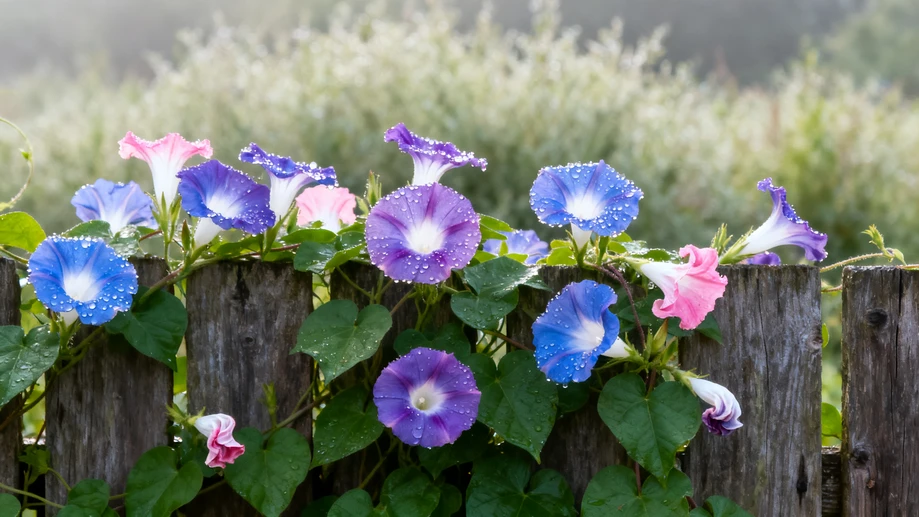
Did You Know Morning Glories Never Last Longer Than A Few Hours Even If You Keep Them In Perfectly Cool Shaded Conditions?
Explore the hidden micro-structure of the morning glory’s delicate funnel shaped petal, and the little known biological rule behind its famously short blooming window that few casual gardeners have ever noticed
Most people who have grown morning glories along backyard fences or seen them sprawling over roadside wild shrub patches share a common misconception. They assume the blooms wilt and curl up by midday solely because of strong direct summer sun, rising temperatures and dry air that suck moisture out of soft plant tissue. A large number of casual plant lovers have tried their own little experiments to test this assumption: they snip fully unopened buds the night before, place the cut stems in vases of cool purified water, and tuck the vases into completely shaded indoor corners with no direct sun exposure at all, hoping the vivid trumpet shaped flowers will stay open for the whole afternoon or even the whole next day. To their surprise, every single bloom still curls up and loses its bright color within two to three hours of fully opening, with no sign of being affected by heat or strong sunlight at all.
This odd phenomenon is directly tied to one of the most unique and delicate external structural features of morning glory blooms, a detail that almost no one pays attention to during casual observation. Unlike most common ornamental flowers that are made of dozens of separate, layered individual petals, a morning glory’s entire bloom is one single, continuous thin sheet of translucent petal tissue that forms the funnel shape, with no separate petal edges attached to independent thick cell layers. Every cell across this entire thin sheet is tuned to reach maximum turgor pressure and full expansion at roughly the same exact moment when the first rays of dawn touch the unopened spiral bud. Once all these cells finish expanding completely, their cell wall structures do not have extra thick fiber layers to maintain that stretched, firm state for extended periods of time, and a pre-set biological switch immediately kicks off programmed cell death across the whole tissue.
You can spot tiny details of this structural trait if you kneel down close enough to a fully open morning glory bloom and observe it under soft natural light. The surface of the whole funnel shaped petal shows a faint, delicate radial pattern of lighter colored veins running from the narrow base all the way out to the rounded outer edge, and these veins are the only slightly thicker areas that give the whole bloom just barely enough support to hold its trumpet shape. The rest of the petal tissue is so thin that you can see light pass right through it when you hold it up, and there is no extra stored moisture reservoir within the tissue to replenish lost water even if you submerge the entire bloom in clean water. Within hours of full opening, the outermost edges of the single petal sheet start to lose tension, fold inward bit by bit, and the whole structure collapses slowly into a soggy, twisted mass that can never regain its original firm, open shape.
This specific structural design is not a random flaw in the plant’s growth pattern, but a highly refined evolutionary adaptation that fits the species’ exact survival needs. Morning glories’ primary targeted pollinators are small solitary bees that only forage for nectar in the first three hours after sunrise, before the air temperature rises high enough for other larger bee species to become active. The plant invests all its stored sugar and nutrient resources into making that one thin, vividly colored large petal sheet that stands out extremely clearly against dim pre-dawn green foliage, rather than wasting extra energy building thick, durable petal tissue that would keep the bloom open for longer periods. It does not need to attract any other pollinator that moves around later in the day, and it can redirect all the saved extra energy into growing new vine shoots and forming more unopened buds for the next dawn.
For home gardeners who love the bright, cheerful color of morning glories and hope to use them as temporary table centerpieces, this tiny structural detail means they will never get the long lasting cut flower effect they expect no matter what commercial flower preservative or special growing trick they try. The best way to enjoy these blooms is to step outside to the fence line right after sunrise, when every new bloom has just finished unfurling from its tight spiral bud, and catch that short window of perfect open form when the pale dew droplets still sit evenly across the smooth petal surface. Most people walk past these common flowers every day for years without noticing this tiny, perfectly tuned detail hidden in plain sight, that makes every single morning glory bloom a short, lovely little gift that only shows its full beauty for a few hours on one single quiet morning.