
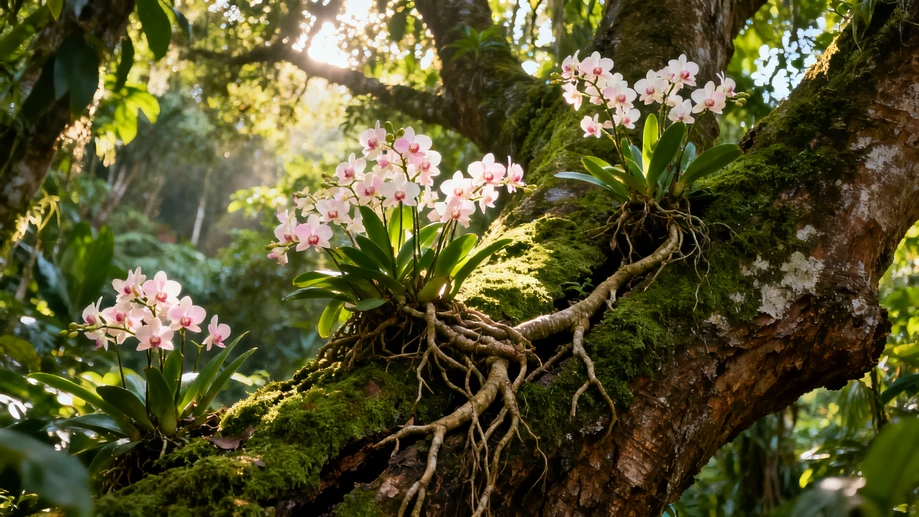
Did You Know That 70 Percent Of Wild Orchids Never Actually Root In Forest Soil At All?
This lesser-known growth habit of wild orchids breaks every common assumption you hold about how these delicate flowering plants survive and spread across different natural habitats.
Walk into any local neighborhood garden supply store, pick up a common phalaenopsis orchid sitting on the shelf, and you will almost certainly hear staff remind you to never overwater it, or the soft fleshy roots will rot quickly. Most home orchid growers tuck their plants into pots filled with loose bark chunks or sphagnum moss, and almost no one questions the default assumption that orchids, like most other ornamental flowering plants, need some kind of soil-like medium to root into. Even many casual nature lovers imagine wild orchids growing in soft, humus-rich dirt on the shaded rainforest floor, tucked under thick layers of fallen leaves, protected from harsh direct sunlight.
This widely accepted assumption could not be further from the truth. More than 70 percent of all documented wild orchid species on Earth are classified as epiphytes, meaning they spend their entire lifecycle rooted not in the ground, but on the surface of other larger plants, almost always the thick trunks and upper branches of mature forest trees. Their thick, pale aerial roots are covered with a porous, sponge-like tissue called velamen, which works like a built-in absorbent towel that pulls moisture directly out of the surrounding air the moment humidity rises, and traps tiny particles of decaying leaf matter, dust and trace organic debris to feed the plant slowly over months. The tiny pockets of leaf litter and forest dust that accumulate in tiny crevices and folds of rough tree bark are more than enough to meet all nutrient needs for a full-grown wild orchid.
This growth habit is not a random, rare quirk of a few orchid species, but a highly refined evolutionary survival strategy that gives orchids massive advantages over plants stuck growing on the forest floor. By perching meters above the ground on tree branches, they get access to far more scattered sunlight that filters through the upper canopy, rather than being stuck in the dim, heavy shade that stunts the growth of most ground-dwelling underbrush plants. They are also completely out of reach of common ground-dwelling pests that love to munch on soft new orchid leaves, including snails, slugs and small foraging insects, and their exposed roots never sit in pooled rainwater that would cause fatal rot in soil-bound plant species. Contrary to common misconception, these epiphytic orchids are not parasitic at all: they never bore into tree tissue or steal nutrients from their host, they only use the trunk as a stable, elevated landing pad.
This little known quirk of orchid growth even explains a lot of the mysterious traits that have long confused casual orchid growers. Wild orchid seeds are smaller than specks of fine dust, light enough to be carried on wind gusts for dozens of kilometers, and they have no stored nutrient reserve to help them sprout. A seed will only successfully germinate if it lands directly on a narrow, shaded bark crevice that already holds the exact strain of symbiotic mycorrhizal fungi that can supply the tiny seed with the food it needs to put out its first root. Once an orchid anchors itself to a good spot on a sturdy tree, it can live for 70 to 100 years, blooming reliably every single spring, putting out new aerial roots that slowly creep further along the surface of the bark as it grows larger.
This simple bit of knowledge also changes the way people approach growing orchids at home, eliminating the common mistake that kills more household orchids than anything else. Most new growers try to tuck orchid roots into dense, nutrient-rich potting soil the same way they would grow a rose or a pothos, smothering the thin, velamen-coated roots that are built to breathe open air directly. Once home growers stop trying to force their orchids to adapt to a soil-bound life, and instead use loose, chunky bark mixes that let air flow freely around the roots, and only mist their plants lightly once every few days instead of pouring water into the pot, the orchids will thrive, blooming year after year with very little extra care. The so-called “delicate” orchid is not a high-maintenance hothouse plant at all, but a clever, highly adapted survivor that has perfected the art of living in mid-air.