
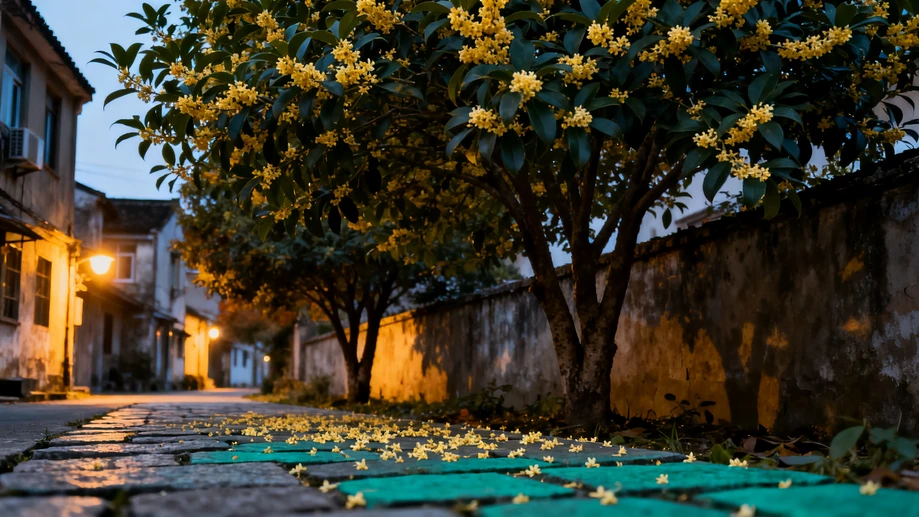
Do You Know the Tiny Creamy White and Golden Flower That Can Perfume a Whole Residential Block All By Itself in Mild Autumn
Few casual strollers in temperate regions realize Osmanthus fragrans releases its signature sweet scent in a uniquely gentle, time-staggered pattern that perfectly matches the slow rhythm of cool fall days
On mild autumn days when the temperature hovers between 15 and 22 degrees Celsius, a distinct sweet, honeyed note often drifts through the air without warning. Most people first assume the scent comes from a nearby bakery pulling fresh honey bread out of the oven, or a batch of fruit jam simmering on a home stove. They walk further down the tree-lined street, and the scent only grows richer, lingering over stretches of paved footpath, past low garden walls, and wrapping around the outer walls of multi-story residential buildings, until they finally spot the source: a cluster of small Osmanthus trees tucked against a boundary fence, dotted with blooms so small they are easy to miss at first glance, no larger than half of a fingernail, with thin, almost translucent pale yellow petals tucked between deep dark green leaves.
What makes this small flowering shrub so unusual compared to other popular fragrant ornamental plants is that it never dumps its full load of aromatic compounds into the air all at once. Roses, jasmine and lavender all release most of their concentrated scent in thick, heavy bursts as soon as the blooms reach full maturity, requiring a large patch of dozens of plants, or a full basket of cut blooms, to fill even a small enclosed room with their signature aroma. A single mature Osmanthus tree, by contrast, carries a total bloom weight of less than one kilogram even at its peak flowering period, but its individual tiny petals are structured to release scent molecules gradually at very low concentrations, moving easily on soft, slow autumn breezes rather than evaporating rapidly into the upper layers of the atmosphere.
This very specific natural trait has shaped how people use Osmanthus for hundreds of years, long before modern commercial air fresheners, synthetic candles and scented diffusers became common household items. No one has ever needed to process large volumes of Osmanthus blooms to extract expensive essential oil to scent public spaces, because simply planting a dozen young Osmanthus saplings along a community footpath, around a public park bench area or along the edge of a small urban green belt will deliver months of soft, consistent sweet scent for free. Windows left open to let in cool fall air will pull that gentle aroma into living spaces, and fabric hung out to dry on outdoor lines, from thick cotton bed sheets to soft knit sweaters, will pick up faint traces of that honeyed sweetness that lingers for hours after the fabric is brought back indoors.
Even more remarkably, the tiny blooms have evolved a precise internal timer for scent release that aligns perfectly with the quietest, most relaxed parts of autumn days. The plants produce almost no detectable scent during the brightest, hottest midday hours, when direct sunlight would make their light aromatic molecules evaporate immediately and drift far above ground level where no one can notice them. They save almost all their scent release for the two to three hours after the sun dips below the horizon, when temperatures drop slightly, winds slow to a soft, almost still pace, and the air close to the ground holds onto the tiny scent molecules long enough to spread evenly across every corner of nearby neighborhoods. This is why so many people report stumbling across Osmanthus scent completely by surprise during quiet evening outings, with no obvious visual sign of the small blooms nearby to give away their presence.
There is no other common ornamental tree that can deliver this kind of subtle, unforced ambient scent experience with so little effort or maintenance. People do not need to schedule special visits to dedicated botanical gardens to catch a whiff of the aroma, they do not need to pay for expensive tickets to special seasonal events, and they do not need to spend money on any processed products to enjoy the full experience. All they have to do is walk down a quiet residential side street lined with mature Osmanthus trees for half an hour on a cool autumn evening, and the soft, sweet scent will cling to their outer clothes gently, staying with them long after they get back home, no artificial additives required, a quiet, free gift from the natural world that makes every ordinary autumn day feel a little warmer and more memorable.