
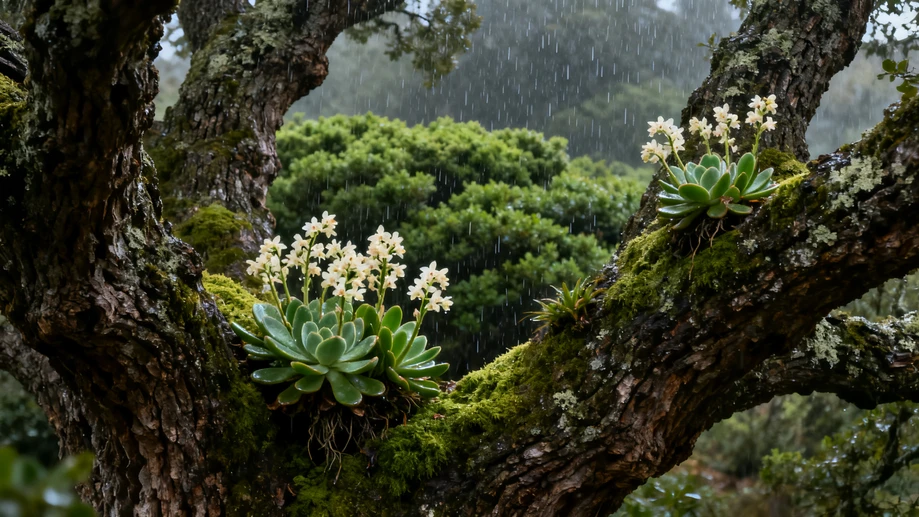
Have You Ever Realized That Most Wild Orchids Never Actually Grow In Ordinary Soil Beds?
Walk through any temperate or tropical woodland and you will spot tiny hidden orchid specimens thriving high on tree bark, far away from the nutrient-rich ground most flowering plants depend on.
The typical idea that all orchids prefer loose, moisture-retentive potting soil lined with bark chips and perlite only applies to a small portion of artificially cultivated ornamental varieties. In natural wild habitats across every continent except Antarctica, more than 90 percent of native orchid species grow as epiphytes, never tapping their delicate roots into the mineral-rich topsoil underfoot. Many of these wild varieties settle at heights of 2 to 20 meters on mature tree trunks and thick upper branches, nesting in narrow crevices where bits of dead leaf, moss debris and wind-blown organic dust accumulate over years of tree growth. This small accumulation of material never reaches more than a few centimeters thick, and it drains completely within an hour after heavy rainfall, which perfectly matches the unique structural traits that have evolved in wild orchid roots over tens of millions of years.
The thick, pale outer layer coating every wild orchid aerial root works like a built-in sponge, capable of absorbing more than 200 percent of its dry weight in water within seconds of contact with rainwater or heavy fog. This porous dead tissue also locks in stored moisture for days, even when the surrounding air turns dry and warm, eliminating the need for the plant to access consistent moisture reserves held deep in ground soil. Unlike parasitic plants that siphon nutrients directly out of their host tree’s vascular system, epiphytic orchids never take any resources from the trees they attach to. All the minerals and sugars they require for full growth come entirely from decomposed organic debris trapped in their tiny growing pockets, as well as trace nutrients dissolved in rainwater and floating freely in ambient air.
This unique growing strategy gives wild orchids a massive competitive edge that no ground-dwelling flowering plant can access in dense forest ecosystems. By moving their entire growing habitat up into the canopy space, they completely avoid competing for limited sunlight, moisture and soil nutrients with sprawling shrub roots, fast-spreading ground cover vines and large herbaceous undergrowth species. The elevated position also creates a far more stable microclimate for their tender new growth, with less risk of sudden frost damage during cold snaps, no chance of being submerged by seasonal ground flooding, and access to consistent gentle airflow that prevents dangerous fungal rot from developing on their tender leaves and buds. The position high on tree branches also puts their tiny, dust-like seeds within perfect range of seasonal wind currents, which carry them for dozens of kilometers to settle on new suitable host trees far away from their parent plant.
Even in heavily populated urban areas, these wild epiphytic orchids can turn up in unexpected hidden spots that almost no one pays close attention to. Old growth trees more than 30 years old, with thick, deeply fissured bark that has developed tiny stable crevices over decades of slow expansion, often host small native orchid colonies that arrived completely on their own. These tiny unassuming plants usually grow no larger than the palm of a hand, with thick fleshy leaves that hold water for weeks, and they only produce clusters of tiny delicate flowers for two to three weeks each spring. They never grow large enough to harm their host tree, and they barely consume any resources from the surrounding environment, making them a completely harmless quiet guest on urban street trees for decades at a time.
Botanists have long used the natural presence of wild epiphytic orchids as a highly reliable indicator of overall ecosystem health in any given region. These sensitive plants cannot survive in areas with high levels of airborne industrial pollutants, or in locations where regular acid rain falls after heavy atmospheric contamination. A naturally established colony of wild epiphytic orchids means the local air quality stays consistently high enough for sensitive species to thrive, the local precipitation has very low levels of dissolved heavy metals or chemical waste, and the surrounding tree population has existed undisturbed long enough to form stable crevice microhabitats that support specialized life forms. This tiny hidden plant, often missed by casual observers, acts as a quiet unspoken marker of a thriving, balanced natural space that requires no artificial intervention to stay healthy.