
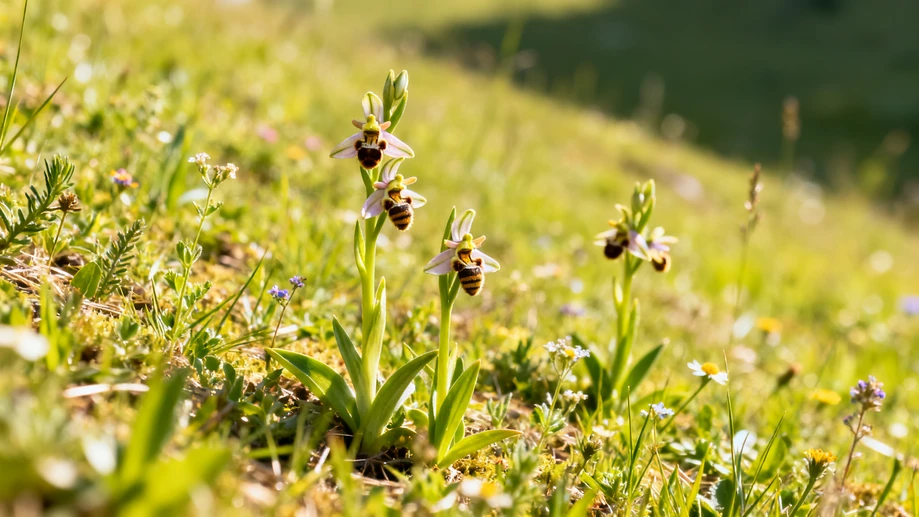
Have You Ever Wondered How Wild Forest Orchids Trick Insects Into Pollination Without A Drop Of Sweet Nectar
This little known orchid trait uses extreme physical mimicry to skip the usual nectar reward most flowering plants offer to their pollinator partners for successful reproduction
If you walk along sun-dappled grassland slopes across the Mediterranean basin in late spring, you will easily spot clusters of fuzzy small blooms tucked between clover patches and thorny thistle fronds. Most of these plants grow no taller than 20 centimeters, with slender green stems holding two to three tiny blooms each. At first glance, the dark brown and deep purple pattern on the largest lower petal looks exactly like a plump female bee resting on the flower surface, even to the eyes of casual passersby. This is the widely distributed bee orchid, one of the most cleverly shaped plant species in the entire orchid family that relies on zero sugary nectar to complete its reproductive cycle.
The mimicry of this special orchid goes far beyond simple color matching on the petal surface. The thick, short fuzz covering the main lip of the flower has the exact same texture as the soft setae on the abdomen of local solitary bee species, and the subtle segmentation lines carved into the petal surface perfectly align with the body segments of a female bee that has just reached sexual maturity. Even the faint translucent patch near the top edge of the lip replicates the soft sheen of a real bee’s thin, membranous wings. At a distance of several meters, male bees cruising the low vegetation for mating partners cannot tell the difference between the real female bees and the carefully shaped orchid petals at all.
Besides the perfect external shape, the orchid also releases a special chemical signal that matches the pheromone produced by virgin female bees perfectly. Male bees drawn to the scent will land directly on the orchid’s lip, trying to complete a mating behavior, and the sticky pollen blocks on the upper part of the flower will attach firmly to the back of the visiting male bee during the process. When the confused male bee leaves the first bloom and is lured to land on a second nearby bee orchid, the pollen block carried on its back will make full contact with the stigma of the new flower, completing the cross pollination process smoothly. The entire transaction costs the orchid no sugar, no amino acid, no nutrient supply at all, saving a huge amount of energy that most other flowering plants have to invest in producing nectar.
The evolutionary logic behind this special shape has been polished over millions of years of natural selection. Every local population of bee orchid adjusts the size and stripe pattern of its lip to perfectly match the dominant solitary bee species living in the same habitat. Individual orchids with slightly more accurate mimicry shapes attract more pollinator visits, produce more mature seeds, and pass on their fine-tuned shape genes to more offspring. Over tens of thousands of generations, the shape of the orchid’s lip has been optimized to a near-perfect level, to the point that researchers even find the curved small bump on the side of the lip exactly matches the small horn structure on the back of the local female bee’s head.
The energy saved from not producing nectar is diverted to other parts of the orchid’s survival system. Bee orchids grow far thinner but far more branched root systems than most other grassland wildflowers, which can drill into tiny gaps in limestone rocks to extract trace minerals that other root systems cannot reach. Their tiny dust-like seeds do not carry any nutrient reserve at all, and can only absorb nutrients from symbiotic mycorrhizal fungi in the soil in the first few months after germination, allowing them to survive in extremely thin, nutrient-poor soil patches where few other flowering plants can take root. This extremely targeted physical mimicry strategy has proven so successful that nearly one in ten species across the entire 30,000+ orchid family uses similar shape-based trickery, rather than the traditional nectar exchange system, to complete pollination.