
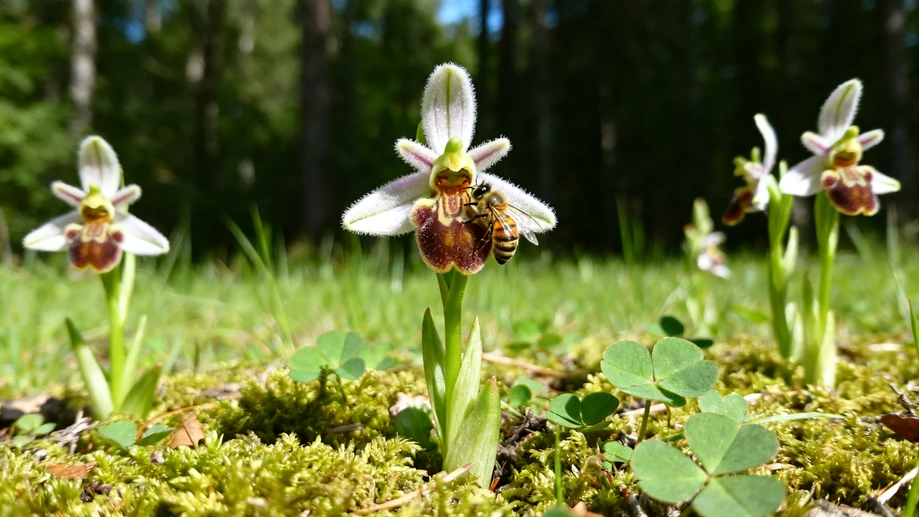
Wait, Did You Know Most Wild Terrestrial Orchids Trick Pollinators By Showing Fake Flower Shapes Instead of Giving Nectar?
This tiny hidden survival trick evolved over 80 million years lets orchid species spread far across every continent except frozen Antarctica with zero unnecessary energy expenditure.
If you have ever wandered through a undisturbed temperate woodland in late spring, you might have stumbled across clusters of small, pale purple wild orchids tucked between patches of moss and low clover. Most casual observers walk past them without a second thought, assuming the tiny blooms work the exact same way as dandelions, clover and other common wildflowers: they produce sweet, sugar-rich nectar to draw bees and other pollinators in, and the pollinators carry pollen from one bloom to the next as a fair trade for the food reward. This universal assumption falls apart completely the second you lean in to check the base of these wild orchid petals, because there is no sticky, sweet nectar anywhere to be found. The entire flower structure is built to do nothing more than trick passing insects into stopping by long enough to pick up and drop off pollen, without offering any kind of payment at all.
The core of this clever trick lies entirely in the highly specialized shape of every wild orchid bloom, modified over millions of years of evolution to match the exact visual cues that local pollinators respond to most strongly. For many common species of wild bee orchids, the lower lip of the flower has developed a perfect 1:1 replica of the body shape of a female solitary bee, right down to the tiny fine fuzz texture on the petal surface, the faint brown and yellow striping that matches a bee’s exoskeleton, and even the small pointed lobe at the bottom of the lip that mimics the shape of a female bee’s folded wings. These blooms do not even need to produce a strong scent, because their shape alone draws overexcited male solitary bees that are searching for a mate, and the small amount of mild pheromone-like chemical they emit reinforces the illusion so well that male bees will land and attempt to mate with the bloom. In the process, the hard, sticky pollen sacs on the top of the orchid’s reproductive structure glue themselves firmly to the back of the bee’s thorax, and stay attached even when the confused bee flies away to look for a real female.
Other groups of wild orchids that do not target mating insects have evolved equally convincing fake flower shapes that copy the exact form of other local wildflowers that are famous for producing massive amounts of high-quality nectar. There are documented orchid species that perfectly replicate every tiny detail of the popular wild geranium bloom that local bumblebees prioritize over all other food sources, right down to the exact placement of deep purple spots on the petal surface, the gentle curve of each individual petal, and even the slight bump at the center of the bloom that marks where nectar collects on the real geranium. When a hungry bumblebee that has already visited several real geraniums spots the orchid bloom, it moves in immediately expecting to find a full serving of nectar, and crawls deep into the flower’s center to search for the sweet liquid. It will scramble around the inside of the bloom for close to a minute before it realizes there is no food there, and takes off, but by that point the pollen sacs stuck to its body from the previous orchid it visited have already brushed off onto the new bloom’s reproductive structure, completing the pollination cycle without the orchid spending a single drop of energy making sugar for the bee.
This seemingly unfair survival strategy has turned orchids into one of the most widespread and diverse flowering plant groups on the entire planet, because all the energy that other flowers spend producing nectar gets redirected toward making tiny, ultra-lightweight orchid seeds. A single fully mature wild orchid plant can produce up to several million individual tiny seeds in a single growing season, each one small enough to be carried for dozens of kilometers on the wind before it settles into a patch of soft, nutrient-rich rotting wood or loose meadow soil to sprout. This ability to skip the energy cost of nectar production also lets wild orchids grow in habitats that are far too low in nutrients to support most other flowering plants, from the thin moss layer on the surface of old rainforest tree trunks to the narrow cracks in limestone cliff faces, and even in the damp, nutrient-poor soil of high altitude alpine meadows where most other flowering plants cannot get enough nutrition to make enough nectar to attract pollinators. Even in the harshest, coldest edges of their growing range, orchids never have to divert limited nutrients to nectar production, so they can survive years of unusually cold weather or drought that would kill off other competing flowering plant species.
It is easy to miss just how incredible this tiny shape-based trick is when you only encounter the large, bright, heavily cultivated ornamental orchids sold in retail plant displays, most of which have been selectively bred for generations to produce large, long lasting blooms that are much more noticeable to human eyes than to their native wild pollinators. Many of these cultivated ornamental orchids have even been bred to produce small amounts of nectar as a side effect of the artificial selection process, but their wild ancestors never lost that clever, subtle shape that lets them outsmart local insects for millions of years without ever giving up a single drop of sweet nectar reward. This tiny little detail hidden in the curve of a single orchid petal is the exact reason the entire orchid family has survived and thrived across so many different habitats for tens of millions of years, long before the first human ever walked through a woodland to spot their tiny, unassuming purple blooms.