
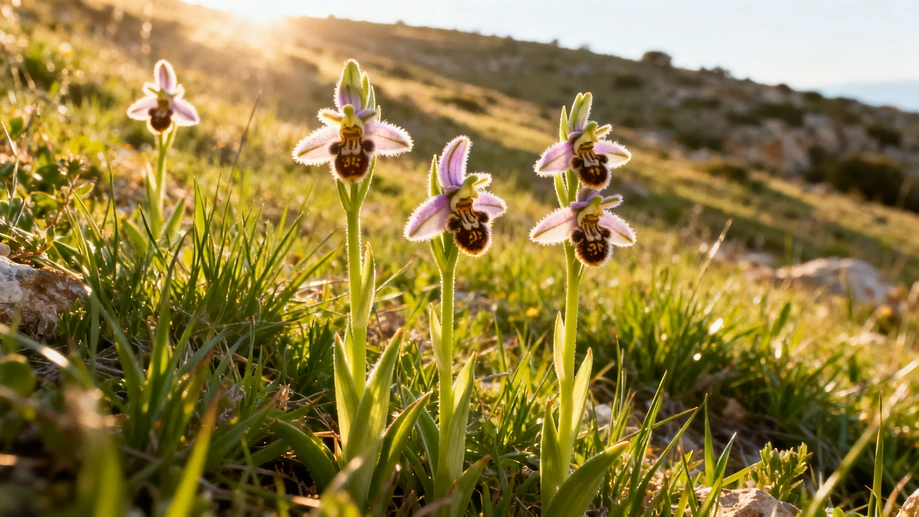
Did you know the tiny wild orchid found in Mediterranean grasslands tricks male bees into pollinating it with bee-shaped petals?
This deep dive into the little known survival trick of the bee orchid covers its weirdly precise mimicry, hidden biological details and the quiet magic you can spot on a casual countryside walk.
If you have ever wandered through sun-dappled grasslands in southern Europe during late spring, you have probably walked right past dozens of these small, unassuming orchids without even noticing them. Most of the plant sits low to the ground, with thin, blade-like green leaves blending in with surrounding grass blades, and only a thin, 20 to 30 centimeter tall stalk rising up to hold its cluster of 2 to 5 small flowers. Unlike the big, flashy hybrid orchids you see sold in grocery stores as houseplants, each bee orchid flower only stretches a few centimeters across, and it takes a sharp, curious eye to catch just how much the lowest, broadest petal looks exactly like the body of a female solitary bee, down to the tiny dark brown fuzz along its edges and the faint, iridescent sheen that mimics the wax coating on a real bee’s exoskeleton. You can kneel down and hold a small magnifying glass up to the petal to catch even finer details: tiny, dot-shaped markings that line the edge of the petal match the exact pattern of hair follicles on the back of the specific bee species it targets, no random smudges or uneven blobs out of place.
This mimicry goes far beyond what you can see with your eyes, too, and that is the part that makes this small orchid’s trick so impressively efficient. Most flowering plants that rely on insect pollination produce small amounts of sweet, sugar-rich nectar to reward visiting bugs for carrying their pollen from bloom to bloom. The bee orchid does not make any nectar at all, which saves it a huge amount of energy that would otherwise go into sugar production, and instead it invests all that extra resource into two key survival tools: perfect visual mimicry, and a custom cocktail of pheromones that is chemically identical to the exact mating attractant female solitary bees release when they are ready to find a mate. Male bees that catch a whiff of this scent from dozens of meters away will ignore every other wildflower in their flight path to zoom straight for the orchid bloom, convinced they are heading to a receptive female bee waiting to mate.
The timing of the bee orchid’s annual growth cycle lines up so perfectly with its target bee species that it feels almost like a pre-planned coordinated routine, rather than a random product of millions of years of evolution. The orchid breaks through the soil and pushes up its flower stalk exactly one week before the female solitary bees of its target species are due to emerge from their underground pupal casings. All the male bees hatch a full week earlier than the females, so they have several days of flying around the grasslands searching for mates with zero real females around to respond to their advances. This narrow window is the bee orchid’s entire pollination season, and the confused, eager male bees will land on the fuzzy petal, try to mate with it, and end up slamming their forehead directly against the small sticky pollen sacs tucked on the top of the flower’s center. When the disappointed bee flies off a moment later, it will carry those bright yellow pollen sacs stuck to its head, and when it lands on the next nearby bee orchid flower, it will deposit the pollen directly onto the sticky stigma of that second bloom to finish the full pollination process.
What is even more remarkable is that every single regional population of bee orchid has adapted its exact petal pattern and pheromone blend to match the specific solitary bee species that lives in its local area. A bee orchid growing in coastal Spain will not attract the same bee species as one growing in the hills of southern France, and their petals will have subtle differences in fuzz color and dot pattern that most human observers can barely pick up on, but the local male bees notice instantly. In areas where a specific local bee population has died out, some bee orchid colonies have even adapted to self-pollinate as a backup, shifting their flower structure slightly to let their own pollen fall directly onto their stigma without any help from a visiting insect. This adaptability is why the bee orchid has managed to survive in open grassland habitats that shift and change with grazing patterns, seasonal droughts and occasional unexpected wildfires for millions of years.
While plenty of large, fancy tropical orchids are prized as decorative houseplants and luxury garden additions, the humble bee orchid has developed a quiet, dedicated fan base among casual naturalists who go on dedicated spring walks to spot them out in their native habitat. No one harvests these small wild orchids to put in pots at home, because they will not survive outside of their specific grassland ecosystem that shares space with their target bee species, and most people who spot a bloom will simply take a few close-up photos before walking away to let the tiny flower carry out its clever little trick on the next confused bee that passes by. There is a quiet, understated beauty to this small plant that puts all its energy into one hyper-specific, perfectly tuned survival mechanism, rather than growing huge, colorful petals to draw in as many random bugs as possible.